
A practical guide to matching a wedding band to your engagement ring, with comfort and style in mind.
Choosing a wedding band sounds simple until you actually start trying rings on. The moment you compare a straight band with a curved one, or a polished finish with a matte one, the decision becomes more personal and more technical at the same time. You are not just picking another ring. You are choosing the piece that needs to live beside your engagement ring for years, possibly every day, and still feel natural on the hand.
The easiest way to approach the decision is to start with the engagement ring you already have. That ring gives you most of the clues you need. Its height, profile, stone shape, metal and proportions all influence which wedding band will look balanced. Once you understand those details, the rest of the choice becomes much simpler.
Start with the shape of the engagement ring
The first thing to look at is how the engagement ring sits on the finger. Some engagement rings are low and compact, while others rise higher because of the centre stone or the setting. A ring with a halo, cathedral shoulders or a larger centre stone often needs a band that is shaped to sit around it rather than underneath it.
A straight band can be a perfect solution when the engagement ring sits close to the hand and does not have a wide setting. In that case, the two rings can line up neatly and create a clean stack. But if there is a visible gap, that is not a mistake. Some people love the space because it gives the set a modern look. Others prefer a band that follows the shape of the ring more closely.
Curved, contoured and wishbone bands exist for exactly this reason. They are made to work with a ring that does not sit like a simple circle on the finger. A gentle curve can soften the stack and make the wedding band feel like it belongs there from the beginning. If you want the two rings to look intentional together, this is often the best place to start.
If you are unsure, take side view photos of the engagement ring and look at them with fresh eyes. The side view usually reveals whether the band needs to nest, curve or stay straight. It is one of the easiest ways to avoid choosing a ring that only looks right from above.
Think about metal before you think about sparkle
Once you know the shape, the next question is metal. Matching metals creates a seamless look, but mixed metals can be beautiful too. A white engagement ring paired with a yellow gold wedding band can look deliberate and modern. A yellow gold engagement ring with a matching gold band can feel warm and timeless. Platinum or white gold can give the whole set a cooler, more refined feel.
Metal choice is not just about colour. It is also about wear. A wedding band is usually worn more often than most other jewellery, so it needs to stand up to daily life. If you are active, work with your hands or simply want a lower maintenance ring, ask the jeweller how the finish will age and what kind of care the metal needs.
It is also worth thinking about how the two rings will age together. Some people like the idea of a wedding band and an engagement ring that both develop a softer look over time. Others want the pieces to stay as close to their original finish as possible. That is a style choice, but it is also a practical one. Different metals can scratch, polish or patina in different ways.
If you are shopping for a ring set rather than two separate pieces, it helps to ask the jeweller whether the bands were designed to be worn together. Some collections have matching profiles that are meant to work as a pair. That can save time and make the final stack feel more polished.
Decide how the band should feel every day
Comfort is one of the most overlooked parts of the decision, but it matters more than almost anything else. A ring can look beautiful in a tray and still feel wrong once you wear it for a few hours. Width, thickness, inner profile and edge shape all change the experience of wearing the ring.
A narrow band often feels light and delicate, but it may disappear visually if your engagement ring is large or highly detailed. A medium width band can feel balanced and easy to wear. A wider band gives more presence, but it can also feel more noticeable on the hand. The right answer depends on the size of the wearer’s hand, the style of the engagement ring and the look you want to create.
The inside profile matters too. Rings with rounded inner edges, often called comfort fit, tend to slide on more easily and feel smoother during daily wear. Flat inner profiles can also work well, especially if you want a lower profile ring or a more contemporary shape. The best way to know is to wear a few different styles for a couple of minutes, not just a few seconds.
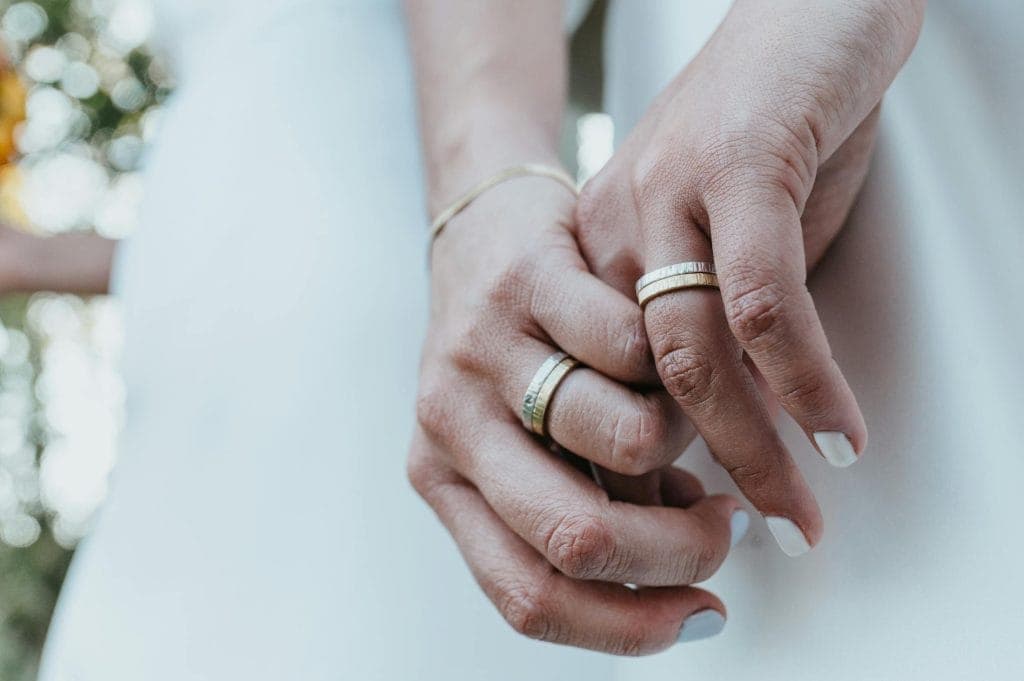
Think about the real world, not just the shop mirror. Will the ring rub against the engagement ring? Will it catch on clothing? Does it feel too tall when you make a fist? Will you forget it is there, or will you keep wanting to adjust it? The best wedding band is the one that fades into the background in the best possible way.
Consider whether you want the band to stack now or later
Some people buy a wedding band purely to finish the engagement ring set. Others plan to build a stack over time with anniversary rings, eternity bands or a second band on the other side of the centre ring. If there is any chance you will stack more rings later, it is worth thinking ahead.
A simple straight band is often the most flexible option because it can work on its own or sit beside other pieces later. A contoured band can be the best choice if the engagement ring needs a close fit right now, but it may be less flexible if you want to add more rings later. A decorative band with stones or engraving can be beautiful, but it can also become the focal point of the stack, which is not always what people want.
If you already know the future stack will matter, try the wedding band with the engagement ring and then imagine a third ring added later. Does the whole set still feel balanced? Does the profile still make sense? If the answer is yes, you are probably making a good long term choice.
This is one reason many jewellers recommend trying the band on in different combinations before making the final decision. Jewellery is not only about the ring itself. It is about how the ring looks when it is part of your everyday life and your evolving style.
Ask a jeweller the questions that really matter
The right jeweller should make this decision easier, not more confusing. Ask whether the band can be custom fitted to the shape of the engagement ring. Ask whether it can be resized later. Ask how the finish will hold up. Ask what happens if the rings do not sit together the way you expected once you get them home.
If the engagement ring comes from a different maker, or if it was bought online, bring photos with you. Side view photos are especially useful. A good jeweller can often tell you quickly whether a straight band, curved band or custom made fit will solve the problem.
If you are shopping online, make sure the product photos show more than the front of the ring. Look for side profiles, measurements and clear descriptions of the band shape. If the seller is vague about fit or returns, that is a sign to slow down and ask more questions.
You should also ask about future maintenance. Will the ring need polishing? Is the band easy to clean? Will engraving affect resizing later? These are the kinds of small details that are easy to ignore until they become important.
A simple way to make the final choice
If you are stuck between a few options, use a simple checklist. Does the band sit well beside the engagement ring? Does it feel comfortable after a few minutes? Does the metal work with your current ring and your style? Will it still make sense if you add another ring later?
If the answer to most of those questions is yes, you are close to the right choice. The perfect wedding band does not need to be the loudest piece in the stack. It just needs to make the set feel complete, balanced and easy to wear.
The best ring is the one you stop thinking about after it is on your hand. When that happens, you usually know you got it right.
Where to go next
Compare jewellers, designers and valuation services across Australia.
Open page Browse custom design studiosUseful when you need bespoke work, remodelling or engagement-ring advice.
Open page View repair and valuation servicesCompare practical aftercare services before you visit a jeweller.
Open pageMore guides to explore

Mazzucchelli’s Chapter 123 Collection: Seven Diamond Designs Explained
A neutral overview of Mazzucchelli’s seven-piece Chapter 123 yellow-gold and natural-diamond collection, with practical details for comparing each…
Read guide
Australian Jewellery Industry Statistics 2026: Directory Report
Explore 2,341 Australian jewellery listings in this 2026 report. See state-by-state data, top services, and where businesses cluster.…
Read guide
How to Choose a Jewellery Making Class
A practical guide to comparing jewellery making classes, including project types, materials, pricing, class sizes and what to…
Read guide
Comments
0 comments
Be the first to comment
Share your thoughts, experience or question below.
Leave a comment
Share your thoughts or ask a question. Your email address will not be published.